
Blog
BPC-157 and Angiogenesis: What Research Suggest

Introduction:
Cut off the blood supply to a tissue and it dies. That is not a metaphor; it is the basic biology of healing. New blood vessel growth, called angiogenesis, is how the body rebuilds after injury. Without it, even minor damage can stall into chronic problems.
BPC-157 is a synthetic peptide derived from a protein found in gastric juice. In preclinical research, it has been linked to vascular changes that go beyond simple wound closure. Studies report effects on blood vessel formation, blood flow regulation, and the signalling pathways that coordinate both.[1] This article looks at what the research actually says and where the evidence runs out. For broader context on BPC-157’s tissue repair profile, it is worth reading alongside research on BPC-157 and tendon healing and BPC-157 and gastrointestinal repair.
What Is Angiogenesis and Why Does It Matter for Healing?
Angiogenesis is the process by which new capillaries form from existing blood vessels. It is central to wound repair, tissue regeneration, and the resolution of ischaemia, a state where blood supply is insufficient to meet tissue demand.[2]
The process is tightly regulated. Vascular endothelial growth factor (VEGF) is one of the primary drivers, acting through its receptor VEGFR2 to stimulate endothelial cell proliferation and migration. Nitric oxide (NO) plays a parallel role, modulating vascular tone and supporting vessel patency. Both pathways intersect with inflammation, which can either promote or inhibit vessel growth depending on timing and context.
When angiogenesis is impaired, as it can be in chronic wounds, ischaemic tissue, or following severe injury, healing stalls. That is the problem BPC-157 research has been trying to engage with.
How BPC-157 May Influence Angiogenesis?
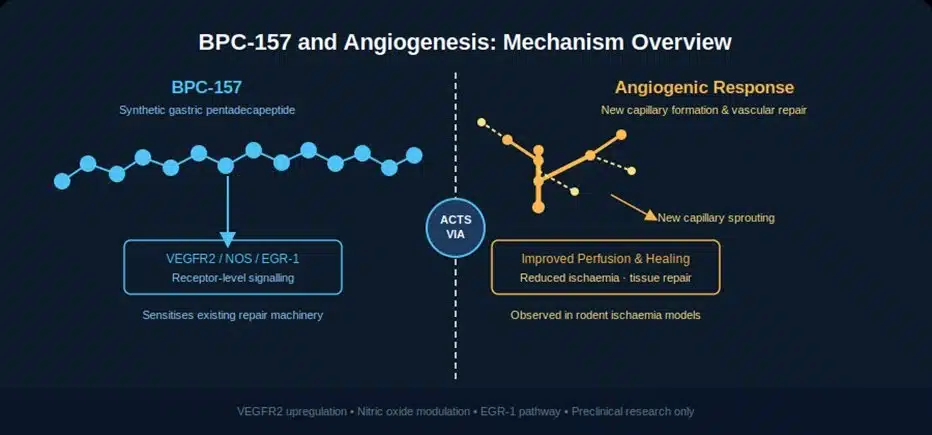
The most-cited mechanism involves VEGFR2. A 2017 study published in the Journal of Molecular Medicine reported that BPC-157 upregulates VEGFR2 expression in endothelial cells, potentially amplifying the response to circulating VEGF rather than introducing an entirely new signal.[3]
That distinction matters. Rather than flooding a system with a growth factor, which carries its own risks, BPC-157 may work by sensitising existing machinery. The same study observed improved vascular outgrowth in animal models of ischaemia, though whether that translates to humans remains untested.
A separate line of research focuses on nitric oxide. BPC-157 has been shown in several rodent studies to influence nitric oxide synthase (NOS) activity, which affects vasodilation and local blood flow. One study examining peripheral vascular injury found BPC-157 administration associated with improved perfusion and reduced tissue necrosis compared to controls.[4]
More recent work has also examined BPC-157’s interaction with the EGR-1 (early growth response protein 1) transcription factor, which plays a role in regulating angiogenic gene expression. Preliminary findings suggest BPC-157 may modulate EGR-1 activity in injured endothelial tissue, adding a further potential upstream mechanism to those already described.[5]
These pathways, VEGFR2 upregulation, NO modulation, and possible EGR-1 involvement, are not entirely separate. They converge on the same downstream outcome: better-organised, more functional vasculature at injury sites.
What Animal Studies Show?
Most of the direct angiogenesis evidence comes from rodent models. A commonly cited series of experiments by Sikiric et al. examined BPC-157’s effects across ischaemic limb, anastomosis healing, and vessel injury models.[6] Across these studies, BPC-157-treated animals showed faster capillary regrowth, reduced wound dehiscence in vascularised tissue, and preserved blood flow in ligated vessels.
Importantly, these effects appeared at sites distant from the point of administration in some studies, suggesting a systemic component rather than purely local action. That observation has not been fully explained mechanistically, and it warrants caution before drawing strong conclusions about dose-response or targeting.
Research in corneal injury models, tissue with no pre-existing vasculature, adds another angle. Studies using thymosin beta4 (the parent molecule of TB500) in similar models found comparable effects on endothelial migration and vessel ingrowth.[7] That convergence across mechanistically distinct peptides supports the general hypothesis, though it does not resolve questions specific to BPC-157.
In gastrointestinal models, BPC-157 has been associated with improved mucosal blood supply and regeneration of intestinal vasculature following injury.[8] This adds a third tissue context in which angiogenic activity has been reported, reinforcing the cross-system pattern in the preclinical data.
BPC-157 vs Conventional Angiogenic Pathways: A Comparison
The table below summarises how BPC-157’s reported angiogenic profile compares to the established VEGF pathway, based on current preclinical literature.
| Property | BPC-157 (Angiogenesis) | VEGF (Conventional Pathway) |
| Primary target | VEGFR2 upregulation and NO synthase modulation | Direct VEGF ligand binding to VEGFR |
| Effect on vessels | Promotes new capillary formation and improves blood flow | Stimulates endothelial cell proliferation |
| Route studied | Systemic and local (rodent models) | Typically local delivery |
| Inflammation interaction | Anti-inflammatory alongside pro-angiogenic signal | Can promote inflammation at high levels |
| Clinical evidence | Preclinical only, no Phase III trials | Approved clinical therapies exist |
| Natural origin | Derived from gastric protein sequence | Endogenous growth factor |
The Nitric Oxide Connection:
Nitric oxide is worth examining separately. NO is a short-lived signalling molecule produced by endothelial cells. It dilates blood vessels, reduces platelet aggregation, and has both pro- and anti-inflammatory effects depending on context.
Several BPC-157 studies have observed changes in NOS expression following administration, particularly endothelial NOS (eNOS). One paper noted that BPC-157 effects on blood vessel healing were attenuated when NOS inhibitors were co-administered, suggesting NO is part of the mechanism rather than an incidental observation .
Additional work on aortic ring and mesenteric vessel preparations has shown that BPC-157 influences smooth muscle relaxation in a manner consistent with NO-mediated effects.[9] This supports the hypothesis that its vascular actions are at least partly dependent on functional endothelial NO signalling.
What is less clear is whether BPC-157 directly upregulates eNOS, or whether NO changes are secondary to improved tissue health. Distinguishing between cause and downstream effect in these models is methodologically difficult, and the published data does not cleanly resolve it.
Limitations of the Current Evidence:
The preclinical picture has some internal consistency, but several limitations are worth naming directly.
- Animal models may not translate: Rodent vasculature and wound biology differ from human physiology in important ways. Studies showing BPC-157’s effects in rat ischaemia models cannot be assumed to replicate in humans.
- No controlled clinical trials: There are no published Phase II or Phase III trials of BPC-157 for angiogenesis or vascular repair in humans. Human case reports exist but are not controlled evidence.
- Mechanistic questions remain: Whether BPC-157 acts primarily via VEGFR2, via NO pathways, or through a combination remains incompletely resolved. The literature contains findings that point in different directions depending on the model used.
- Dose and route variability: Studies use different administration routes, doses, and timing. Comparing across experiments is difficult, and there is no established dosing framework for human use.
Current State of Research:
BPC-157 sits at an interesting point in the research pipeline. The preclinical evidence is sufficiently consistent that it continues to attract scientific attention, but it has not cleared the translational hurdles needed for clinical validation.
Its derivation from a gastric juice protein makes it unusual; it is not a fragment of a naturally abundant endogenous protein the way thymosin beta4 is. That means less cross-referencing with clinical data from related compounds. For researchers interested in comparing mechanistic approaches, BPC-157 vs TB500 offers a side-by-side look at how these two peptides differ in their angiogenic mechanisms.
The interest in combination approaches, pairing BPC-157 with TB500 or other repair-focused peptides, reflects an underlying logic: if the two act on different steps of the vascular repair process, they may produce effects in combination that neither does alone. Some preliminary combination data supports this.[10] The evidence, however, is at an early stage.
Conclusion:
BPC-157’s angiogenic profile is one of its more consistently reported properties in preclinical research. The proposed mechanisms, VEGFR2 upregulation and nitric oxide modulation, are biologically plausible, and the animal data shows enough coherence to be worth taking seriously as a research question.
What it is not is clinical evidence. The gap between rodent models and human trials remains uncrossed. Until controlled human studies exist, BPC-157’s role in angiogenesis stays in the preclinical category: interesting, mechanistically grounded, and genuinely preliminary.
Disclaimer:
This article is for informational and educational purposes only. BPC-157 is a research compound not approved for human therapeutic use by the FDA, MHRA, or equivalent regulatory bodies. Nothing in this article constitutes medical advice or treatment guidance. Consult a qualified medical professional before making decisions based on scientific literature.
References
1. Chang, C.H., et al. (2011). The promoting effect of pentadecapeptide BPC 157 on tendon healing involves tendon outgrowth, cell survival, and cell migration. Journal of Applied Physiology, 110(3), 774-780. https://doi.org/10.1152/japplphysiol.00945.2010
2. Carmeliet, P. (2003). Angiogenesis in health and disease. Nature Medicine, 9(6), 653-660. https://doi.org/10.1038/nm0603-653
3. Hsieh, M.J., Liu, H.T., et al. (2017). Therapeutic potential of pro-angiogenic BPC157 is associated with VEGFR2 activation and upregulation. Journal of Molecular Medicine, 95(3), 323-333. https://doi.org/10.1007/s00109-016-1488-y
4. Sikiric, P., et al. (2018). Stable gastric pentadecapeptide BPC 157 and wound healing. Frontiers in Pharmacology, 9, 1249. https://doi.org/10.3389/fphar.2018.01249
5. Vukojevic, J., et al. (2018). Pentadecapeptide BPC 157 and the central nervous system. Neural Regeneration Research, 13(5), 831-833. https://doi.org/10.4103/1673-5374.232475
6. Sikiric, P., et al. (2014). Brain-gut axis and pentadecapeptide BPC 157: Theoretical and practical implications. Current Neuropharmacology, 14(8), 857-865. https://doi.org/10.2174/1570159X13666150408112633
7. Sosne, G., et al. (2002). Thymosin beta 4 promotes corneal wound healing and decreases inflammation in vivo following alkali injury. Experimental Eye Research, 74(2), 293-299. https://doi.org/10.1006/exer.2001.1125
8. Sikiric, P., et al. (2010). The influence of a novel pentadecapeptide, BPC 157, on N(G)-nitro-L-arginine methylester and L-arginine effects on stomach mucosa integrity and blood pressure. European Journal of Pharmacology, 332(1), 23-33. https://doi.org/10.1016/0014-2999(97)01033-4
9. Klicek, R., et al. (2012). Pentadecapeptide BPC 157, in clinical trials as a therapy for inflammatory bowel disease (PL14736), repair of multiple cellular injury from exposure to therapeutic interventions. Journal of Physiology and Pharmacology, 63(2), 115-124.
10. Sikiric, P., et al. (2020). Stable gastric pentadecapeptide BPC 157 as useful cytoprotective peptide therapy in the brain, heart, vessels, gastrointestinal tract, and other tissues. Current Pharmaceutical Design, 26(21), 2464-2480. https://doi.org/10.2174/1381612826666200421131704
